
Something I’ve never understood is the grade levels in Haiti. Unlike the American system, which is defined by grade levels, Haiti uses terms like Filo, Reto, Segondè, and others that don’t sound like anything in English.
Here’s another example: you can’t just ask “What grade are you in?” by saying, “Nan ki grad ou ye?” Sure, grad is a Haitian Creole word, but it generally refers to someone’s position, rank, or level of prominence — not their grade level in school.
Some Haitians might say that Filo is the same as the 12th grade in the United States, but with a little research, you’ll find that this isn’t entirely accurate.
So, what are the grade levels in Haiti? And how do they compare to the United States? Along the way, enjoy learning new vocabulary and phrases to help you have meaningful conversations with Haitians—especially children, teenagers, college students, and parents.
Knowing this will help you guide Haitians through the American school system since you’ll better understand their education level and what they’ve already learned.
You’ll understand why a Haitian might say, “I didn’t finish high school until I was 19 years old.”
Want more vocabulary, key sentence patterns, and a deeper dive into the educational system in Haiti—along with native content to fully equip you for meaningful conversations with Haitians about their school experiences?
The Grade Levels in Haiti
Swipe to see how Haitians from different age groups may describe grade levels in Haiti. We asked dozens of Haitians who were born in the following time periods:
- Before the 1980s
- Between 1980 – 2000
- After 2000
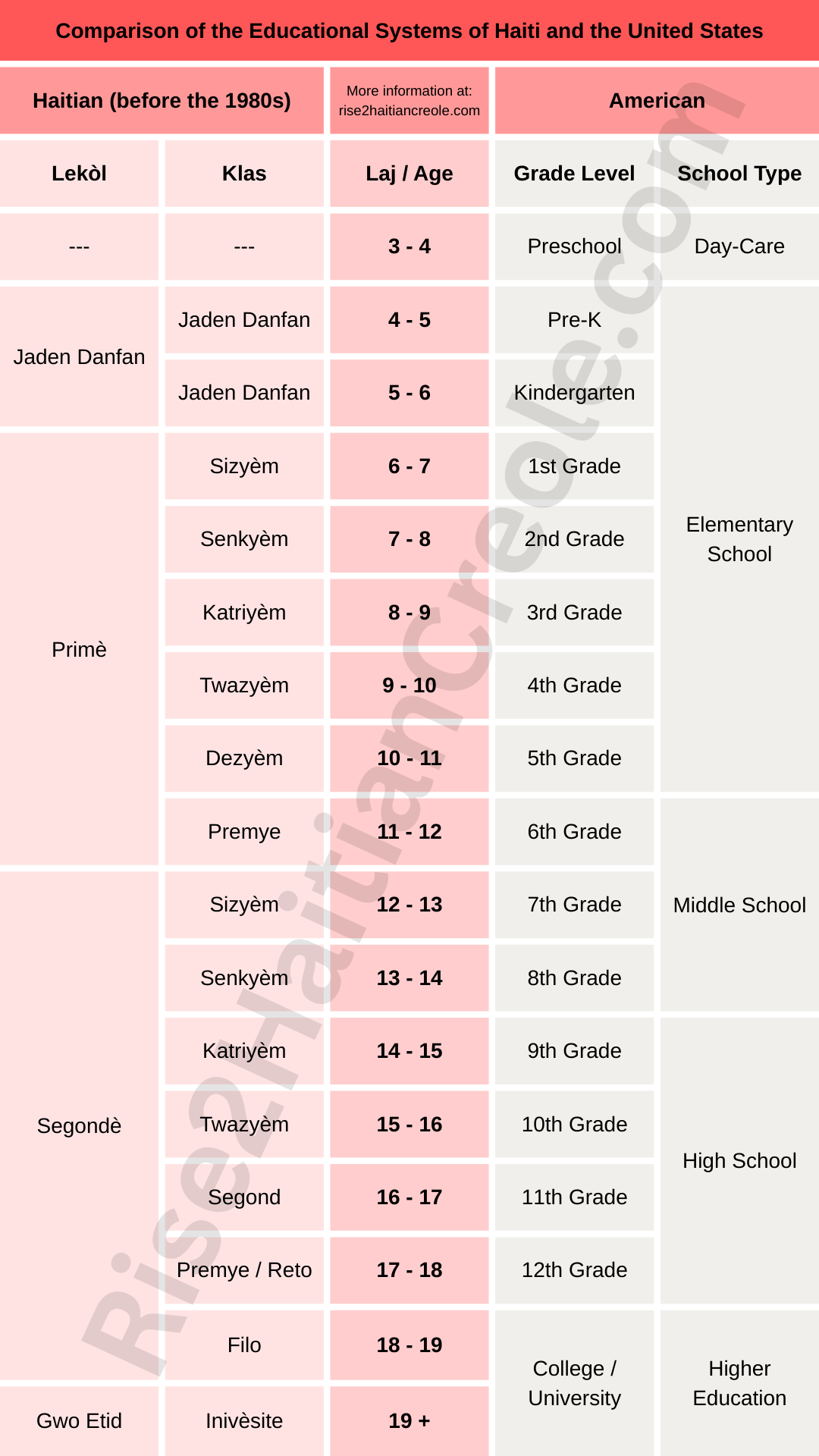
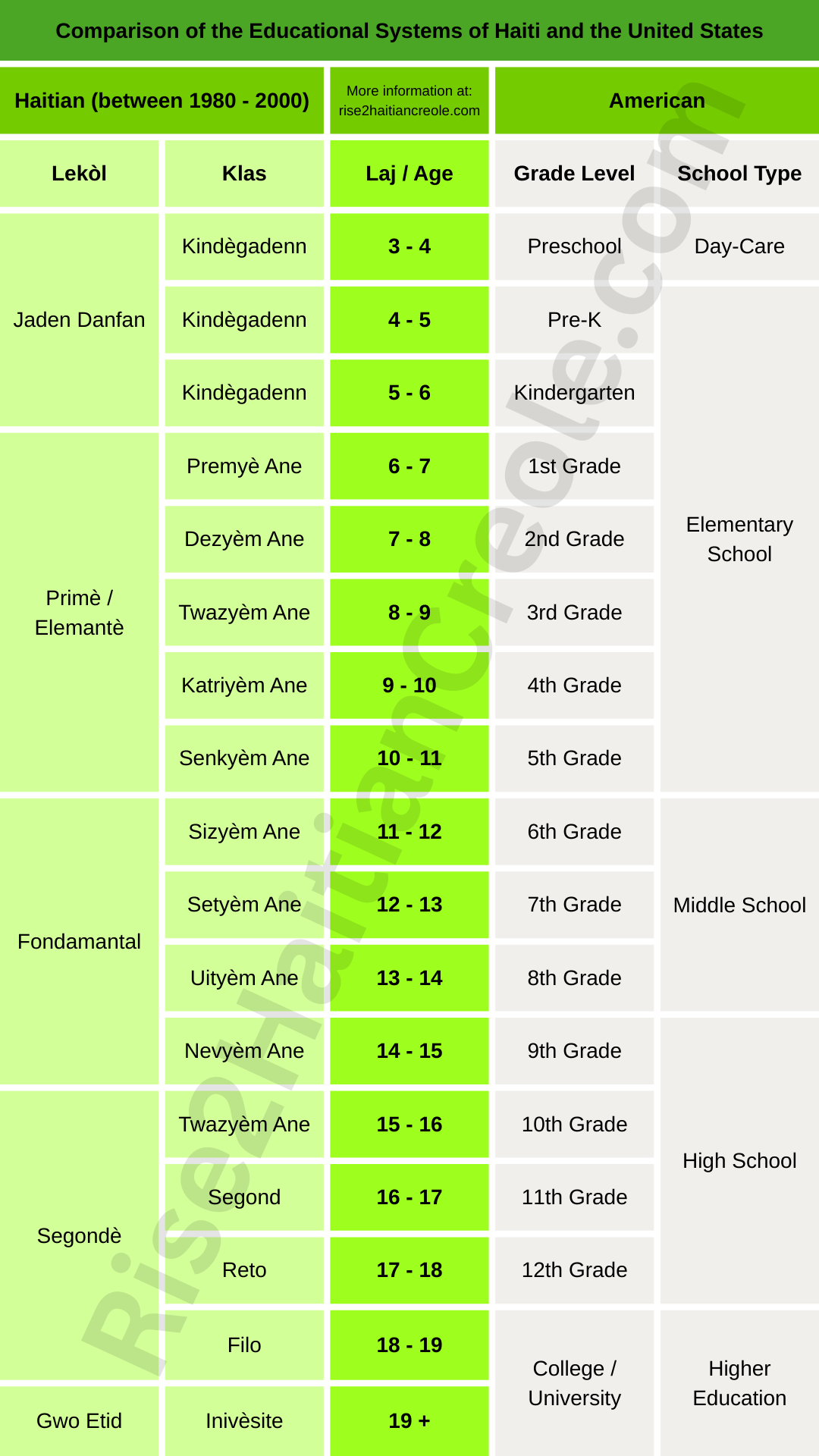
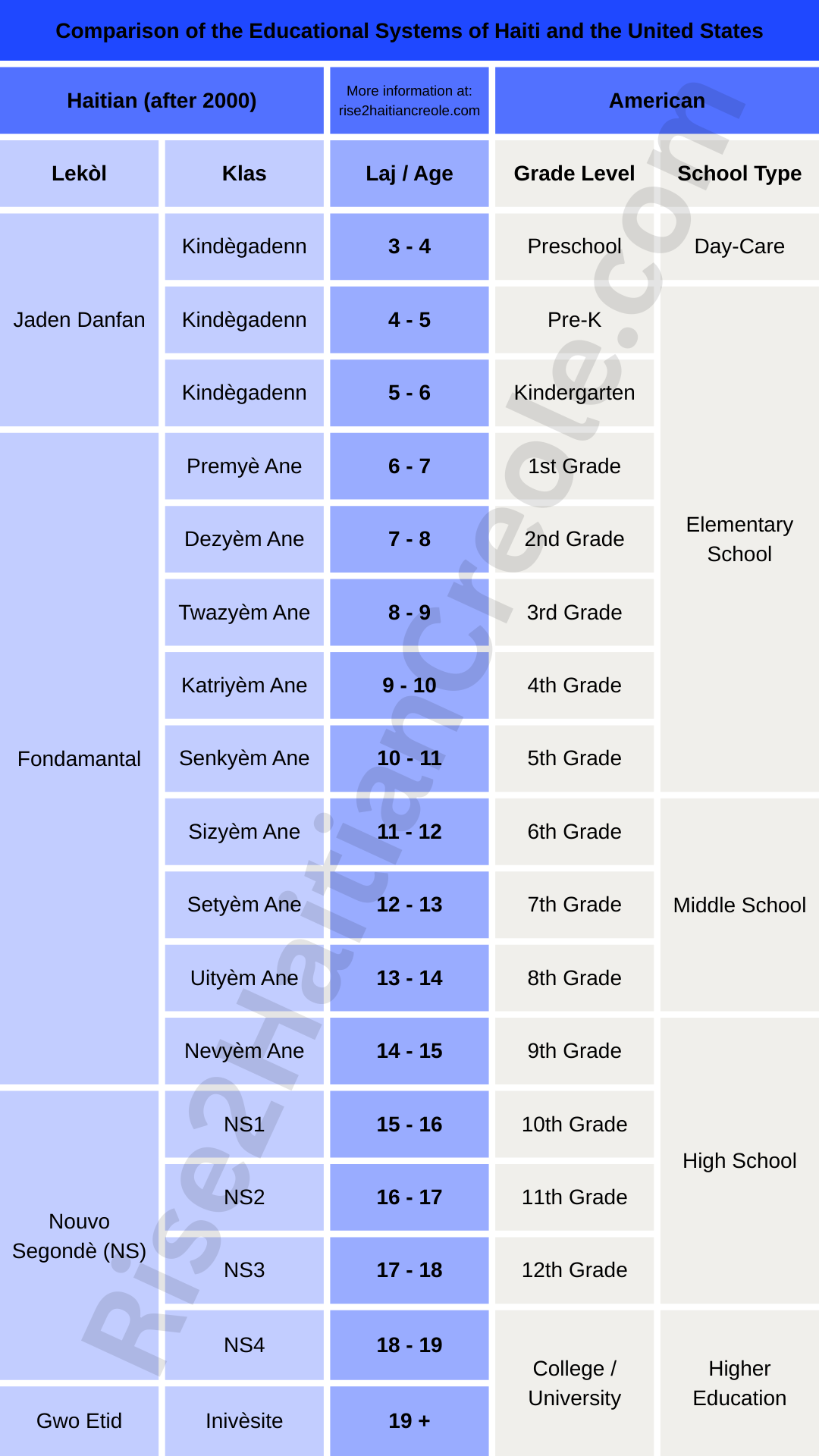
Key Notes
- The timeframes for the Haitian portion (e.g., before the 1980s) are approximate and may vary depending on the person you’re speaking with. The education system in Haiti has changed over the years.
- When comparing grades in Haiti and the United States, it’s sometimes clearer to specify ages rather than grade levels to avoid confusion. Of course, if you’ve memorized the Haitian grade system, feel free to use it confidently. Haitians sometimes explain their school system by comparing it to U.S. grades, but this often leads to more confusion.
- We created our infographic based on conversations with dozens of people from Haiti. The official education system in Haiti may differ, similar to how the meaning of elementary and middle school can differ depending on where you are in the U.S. We’re sharing this information as a Haitian would explain it.
- In Haiti, the grade level and type of school a student entered, official or not, often came down to the money or connections their parents had.
- As you can see, a key difference is that Haitians usually complete their required education at 18 or 19 years old, while Americans typically finish at 17 or 18. This is why a Haitian who has just come to the U.S. might say, “I haven’t finished high school yet”, even though they’re 19.
- Nowadays (as of August 2025), the current generation of Haitian youth no longer use Reto and Filo. These terms have been replaced with NS, or Nouvo Segondè. Again, it depends on the age of the person you’re speaking with and what it was called when they were in school.
Key Sentences
- Refer to the appropriate infographic based on the year the Haitian went to school